

An everyday object, reimagined with intelligence and empathy, has just received international recognition. Behind its vibrating keys lies a major challenge: restoring digital autonomy to thousands of people living with Parkinson’s disease.
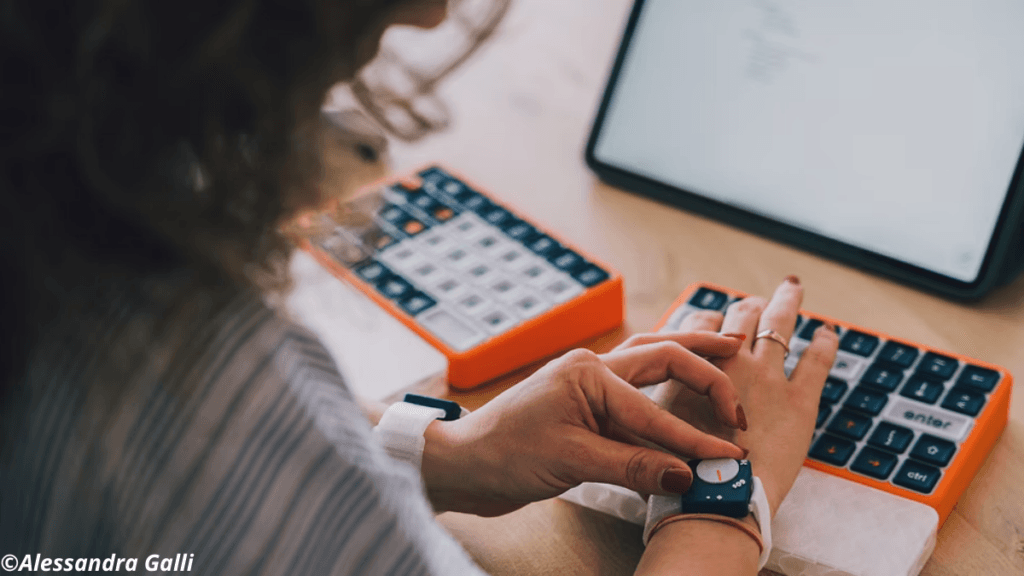
- OnCue is an innovative keyboard designed to help people with Parkinson’s disease regain digital independence in their daily lives.
- It combines adapted ergonomics (ortholinear layout, split keyboard) with haptic and visual signals to stabilize typing.
- Progressive vibrations and smart lighting accompany the movement and limit errors caused by tremors and slow motor skills.
- The project, developed by designer Alessandra Galli, was awarded the 2025 James Dyson Award for its significant societal impact.
- Beyond technology, OnCue aims to restore dignity, expression, and digital inclusion for people living with Parkinson’s.

Parkinson’s disease: when writing becomes a daily challenge
In France, more than 272,500 people are living with Parkinson’s disease, and nearly 25,000 new diagnoses are made each year, according to figures cited by the Ministry of Health. This neurodegenerative condition causes tremors, slowness of movement, and a progressive deterioration of fine motor skills, as described by researchers at Inserm. Beyond the medical issues, these symptoms severely complicate actions that have become essential: writing a message, sending an email, working on a computer.
It is precisely this daily difficulty that OnCue aims to address. OnCue is an innovative keyboard designed by Italian designer Alessandra Galli. Initially developed as part of her master’s degree at TU Delft, the project was recently recognized at the 2025 James Dyson Award, in the category of innovations with strong societal impact.
A keyboard designed for the realities of the body
At first glance, OnCue already stands out from conventional keyboards. Its ortholinear layout, with keys aligned in columns and regular rows, encourages a more natural finger posture and limits unnecessary lateral movements. The keyboard is also split into two independent modules, allowing each hand to position itself freely, thereby reducing strain on the wrists and forearms.
But the innovation goes beyond ergonomics. OnCue integrates haptic and visual signals designed to support movement. With each key press, subtle vibrations are triggered in the keyboard and in wrist-worn bracelets. Their role is to help the user maintain a steady typing rhythm. If a key is held down for too long, a common occurrence among people with Parkinson’s disease, the intensity of the vibration increases, gently prompting the user to release the gesture.
Parkinson’s disease: when technology supports movement
The device also relies on an intelligent lighting system. Thanks to predictive software assistance, certain keys light up to suggest the next letter, reducing hesitation and therefore errors. The entire system is fully customizable, allowing it to adapt to the progression of symptoms, which can vary greatly even within the same day.
This approach is directly inspired by techniques used in motor therapy, where external sensory cues, tactile or visual, can improve the precision of movements. Studies have shown that even a simple tactile cue can significantly reduce fine motor errors in patients.
OnCue: recognition beyond design
If OnCue captured the attention of the James Dyson Award jury, it was as much for its technical sophistication as for its philosophy. Unlike many assistive devices, often perceived as stigmatizing or purely medical, this keyboard claims a refined design, intended to fit just as well into professional environments as domestic ones.
Developed in collaboration with patient associations, including ParkinsonNL, the project was tested with people directly affected by the disease. Their feedback confirmed one essential point: beyond the reduction in typing errors, it is the regained sense of control and dignity that most strongly resonates with users.
Parkinson’s disease: reclaiming a place in the digital world
At a time when social, administrative, and professional life largely takes place through digital tools, the loss of autonomy when using a keyboard can become a factor of isolation. In this sense, OnCue is not limited to a technological achievement; it acts as a bridge between people living with Parkinson’s disease and an increasingly dematerialized world.
Alessandra Galli now has a clear ambition: to make this device accessible to as many people as possible and to explore its adaptation to other neurodegenerative diseases. This approach is a reminder that sometimes it is not spectacular treatments that transform everyday life, but simple objects, thoughtfully redesigned.
With OnCue, technology does not claim to erase the disease. It supports movement, respects its rhythm, and gives back to those whose hands tremble an essential freedom: the ability to write and, therefore, to express themselves freely.
Published by the Editorial Staff on