Detecting Alzheimer’s disease before the first visible symptoms appear remains one of the greatest challenges in medical research. Long silent, this neurodegenerative condition can alter the brain for years, or even decades before memory problems become noticeable in everyday life. In this context, a scientific breakthrough from the United Kingdom is generating significant interest: a simple, non-invasive three-minute brain test that could identify the earliest signs of cognitive decline associated with Alzheimer’s disease.
British researchers have developed a rapid brain test designed to detect early signs of Alzheimer’s disease.
Called Fastball EEG, the test is based on a passive electroencephalogram (EEG) that measures “familiarity memory,” one of the first cognitive functions affected in Alzheimer’s.
Results show reduced brain responses in individuals with mild cognitive impairment (MCI) who are at risk of progressing to Alzheimer’s.
The device is simple, portable, and relatively inexpensive, and can even be used outside hospital settings, including in patients’ homes.
This innovation could improve early screening and allow patients to be referred more quickly for monitoring and appropriate treatment.
Early diagnosis: a potential game changer
Although Alzheimer’s disease cannot currently be cured, early diagnosis and intervention can slow its progression and improve quality of life. Yet diagnosis often occurs at an advanced stage, when significant brain damage has already taken place.
Existing diagnostic tools (primarily cognitive tests, brain imaging, and cerebrospinal fluid analysis) have limitations. They can be time-consuming, invasive, expensive, and influenced by factors such as educational level or patient anxiety.
To address these challenges, British researchers have developed a radically different approach, relying on a direct and passive measurement of brain activity.
Fastball EEG: a quick and passive approach
The research was conducted by teams at the University of Bath and the University of Bristol and published in the scientific journal Brain Communications.
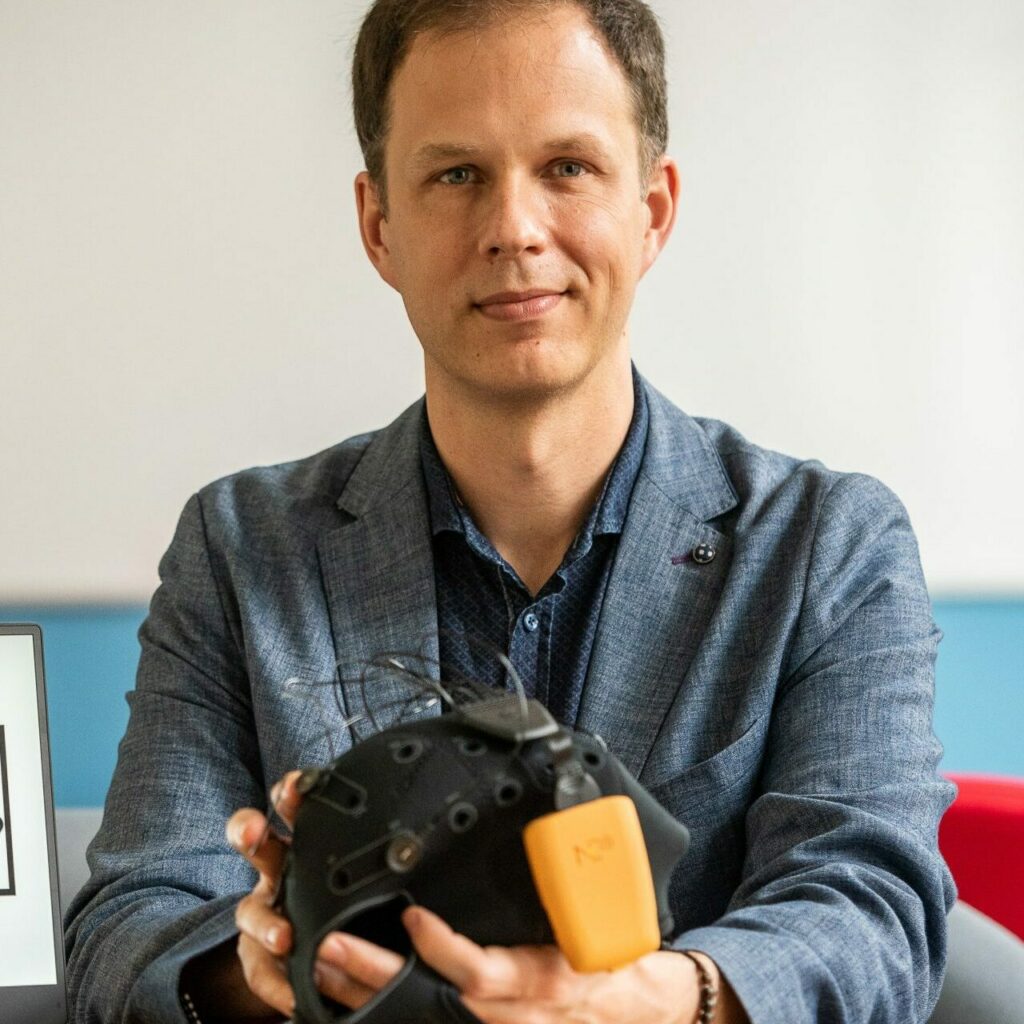
The Fastball EEG test involves placing a cap fitted with electrodes on the participant’s head to record electrical brain activity while they view a rapid stream of images. No complex instructions are given: participants are not asked to memorize anything or answer questions.
The brain automatically reacts to certain images it has seen a few minutes earlier. These unconscious neural responses form the basis of the analysis.
According to Dr. George Stothart, neuroscientist and lead author of the study, this method provides an objective measure of “familiarity memory,” one of the earliest brain functions affected in Alzheimer’s disease.
“With current diagnostic tools, we are missing the first 10 to 20 years of cognitive decline in Alzheimer’s disease. This research [Fastball] offers a way to change that.”
Dr. George Stothart
Promising results in at-risk patients
The study involved healthy adults as well as individuals with mild cognitive impairment, a transitional condition that can precede Alzheimer’s.
Researchers found that participants with memory-related (amnestic) cognitive impairment showed significantly reduced brain responses during the test compared with healthy individuals or those whose cognitive difficulties were unrelated to memory.
These findings suggest that Fastball EEG can accurately identifyindividuals most at risk of progressing to Alzheimer’s disease, well before a conventional clinical diagnosis is possible.
One of the most striking aspects of this innovation is its logistical simplicity. The equipment is portable, relatively low-cost, and can be used outside specialized hospital centers.
In fact, the tests conducted in the study were performed directly in participants’ homes, reducing stress and improving acceptance of the procedure.
In the future, researchers envision the test being used in general medical practices, or even at home, opening the door to wider and earlier cognitive screening.
This prospect is particularly significant as new treatments developed internationally, such as Donanemab and Lecanemab, have shown the greatest effectiveness in the earliest stages of Alzheimer’s disease.
Further steps before clinical application
While the results are encouraging, researchers remain cautious. Fastball EEG alone cannot definitively predict who will develop Alzheimer’s disease. It is designed as an early detection tool to help guide patients toward further testing and appropriate follow-up care.
The next step will be to evaluate the device in general practitioners’ offices to assess its usefulness in everyday clinical practice and across broader, more diverse populations. Long-term follow-up studies will also be necessary to confirm its ability to predict the progression of cognitive decline.
A potential shift in prevention strategy
By focusing on rapid, accessible, and direct measurement of brain activity, Fastball EEG represents a new generation of screening tools centered on early detection rather than late-stage diagnosis.
While not yet a definitive diagnostic solution, this test could help reshape the strategy for tackling Alzheimer’s disease: intervening earlier, better identifying at-risk individuals, and maximizing the impact of available treatments.
We use cookies to ensure that we give you the best experience on our website. If you continue to use this site we will assume that you are happy with it.