
The Silver Economy market, covering products and services designed for older adults—is no longer a niche segment. As the global population ages, it has become a major economic driver. This is confirmed by the latest 2026 figures from Silvereconomy.com, as a follow-up to the report “Silver Economy Market 2025: A Growing Opportunity”, which highlights a growth dynamic that is both durable and structural.

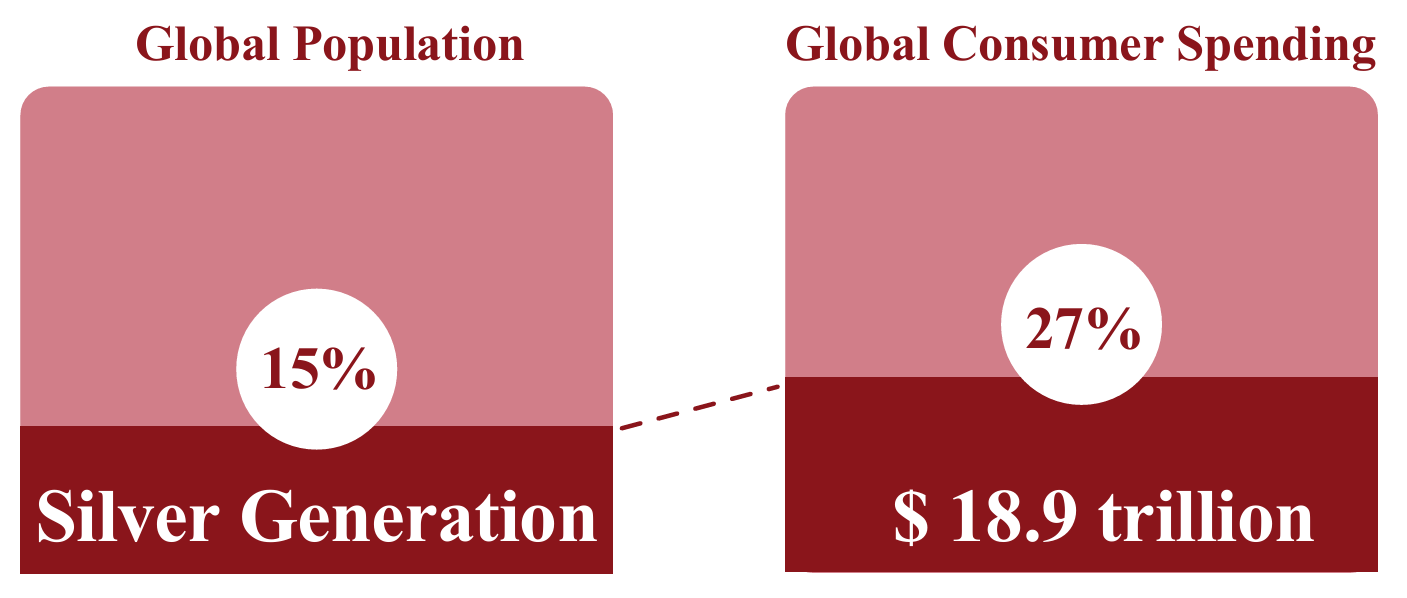
- The Silver Economy has become a major global economic force, driven by demographic ageing, with people over 60 representing 27% of global private consumption—nearly $18.9 trillion—despite making up only 15% of the world population.
- The market is now valued at $4.5 trillion, structured around four key segments—Silver Living & Care, Longevity Health, Longevity Finance and Senior Tourism—plus $609 billion in adjacent markets such as integrated retirement communities and lifelong learning.
- All major segments are experiencing sustained growth, ranging from 6.3% to 7.3% annually, reflecting rising demand for care solutions, preventive health, financial security and services adapted to longer, more active lives.
- AgeTech, valued at $286 billion, acts as a cross-cutting enabler, supporting innovation across the broader Silver Economy through connected devices, AI, remote monitoring and smart home technologies.
- Beyond market growth, the Silver Economy reflects a structural transformation, positioning longevity as a strategic driver of innovation, consumption and economic development in the decades ahead.
A Demographic Shift Reshaping the Economy
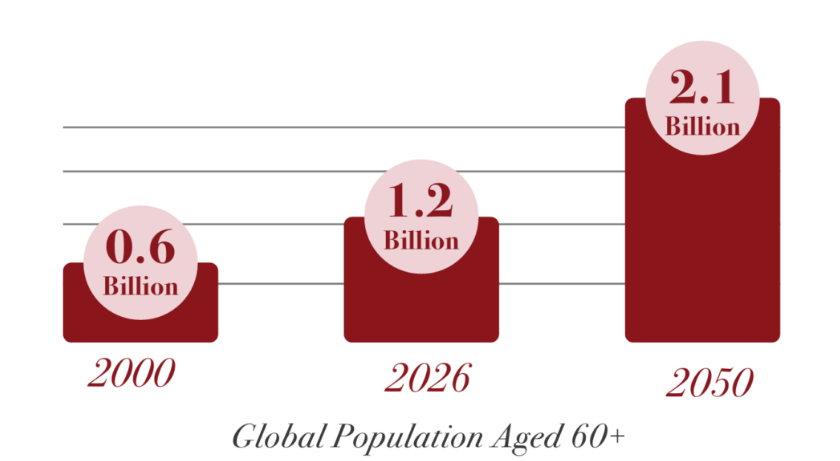
Since 1960, global life expectancy has increased by more than 20 years. Today, 1.2 billion people are over the age of 60, a figure projected to reach 2.1 billion by 2050. This shift is reshaping economic balances and consumer markets at a profound level.
Seniors and Boomers: A Generation at the Heart of Global Consumption
Long perceived as a population on the margins of economic activity, the “Silver Generation” has become a central force in the economy, a growth engine in its own right. People aged 60 and over now account for 27% of global private consumption, representing nearly $18.9 trillion (source: World Data Lab, 2026), out of an estimated $69.75 trillion in worldwide private consumption across all age groups, while representing only 15% of the global population.
This signals a profound transformation: older adults are no longer simply recipients of services. They have become a structurally important consumer group, with growing expectations around health, comfort, autonomy, and quality of life.
A $4.5 Trillion Market
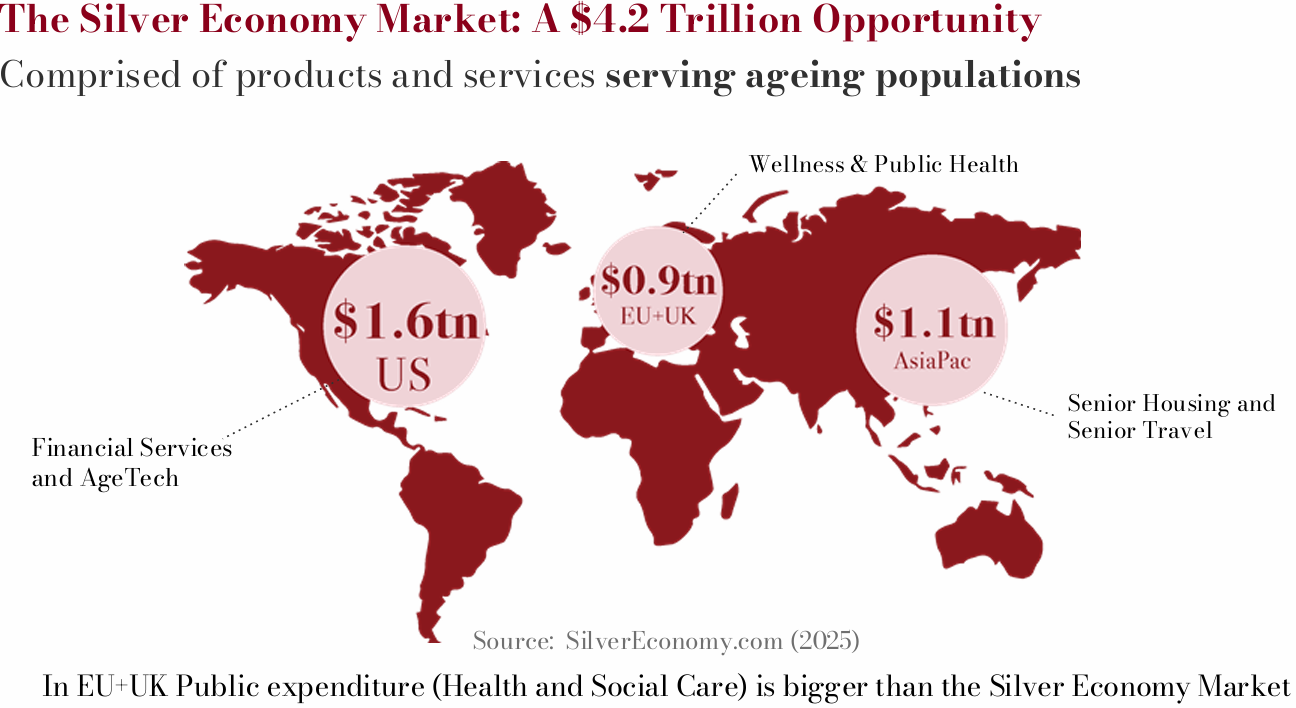
Today, the Silver Economy represents a global market valued at $4.5 trillion. That market is built around four core segments, complemented by $609 billion in adjacent markets, including integrated retirement communities (IRCs) and lifelong learning.
Key Silver Economy Segments
Silver Living & Care
The Silver Living & Care market, valued at $1.3 trillion, encompasses housing solutions, home-based services and support systems for daily living. It remains one of the most foundational segments, positioned at the heart of autonomy and dependency-related challenges.
With average annual growth of 6.4%, the market reflects rising needs driven by demographic ageing and growing demand for support and care solutions.
Longevity Health
The Longevity Health market, valued at $900 billion, is experiencing particularly strong momentum. It spans preventive medicine, ageing-related treatments, and wellness approaches aimed at extending quality of life.
Driven by 7.3% annual growth, the highest rate among these segments, this market reflects growing investment in prevention, medical innovation and solutions designed to support longer, healthier lives.
Longevity Finance
The Longevity Finance sector, also estimated at $900 billion, responds to challenges created by longer life expectancy, including pensions, insurance, wealth management and income security.
With average annual growth of 6.3%, the segment highlights how the financial sector is adapting to the economic realities of longevity.
Senior Tourism
The Senior Tourism market, valued at $800 billion, reflects changing lifestyles among older consumers. More active and mobile than previous generations, seniors are investing more in travel, wellness and cultural experiences.
Its 6.9% annual growth underscores the increasing weight of older consumers in tourism and leisure industries.
AgeTech: A Cross-Cutting Driver
Alongside these segments, AgeTech, valued at $286 billion, cuts across the broader market.
Connected devices, artificial intelligence, remote monitoring solutions and smart home technologies are helping strengthen autonomy, safety and quality of life for older adults.
A Structural Transformation
Beyond these core markets, emerging sectors such as integrated retirement communities and lifelong learning already represent several hundred billion dollars in value.
Together, they point to a broader paradigm shift: ageing no longer means withdrawal from economic and social life, but continued participation, learning and consumption. While the growth of the Silver Economy has been documented for years, the 2026 data confirms that this is not a temporary trend, but a lasting structural transformation.
Longer lives, combined with changing societal expectations, require rapid adaptation from both businesses and public policy.
A Strategic Opportunity for the Years Ahead
With nearly $19 trillion in annual spending and sustained growth, the Silver Economy is establishing itself as one of the major economic forces of the 21st century. For businesses, the question is no longer whether this market matters, but how to position within it strategically.
Because behind these figures lies a deeper transformation, one that is redefining innovation, consumption and ageing itself.
The latest Silver Economy Market 2025 report is available: complete the form to request your copy.
Meet the authors at the SilverEco & Ageing Well International Festival: register for your free B2B pass today.
Published by the Editorial Staff on